Media & Information / ITB Promotes Quality Culture and Pzrepares Students for the Global Industry through SNI Goes to Campus
Corporate Info • 15 Sep 2026

Tuesday, September 15, 2026, 10:22:54
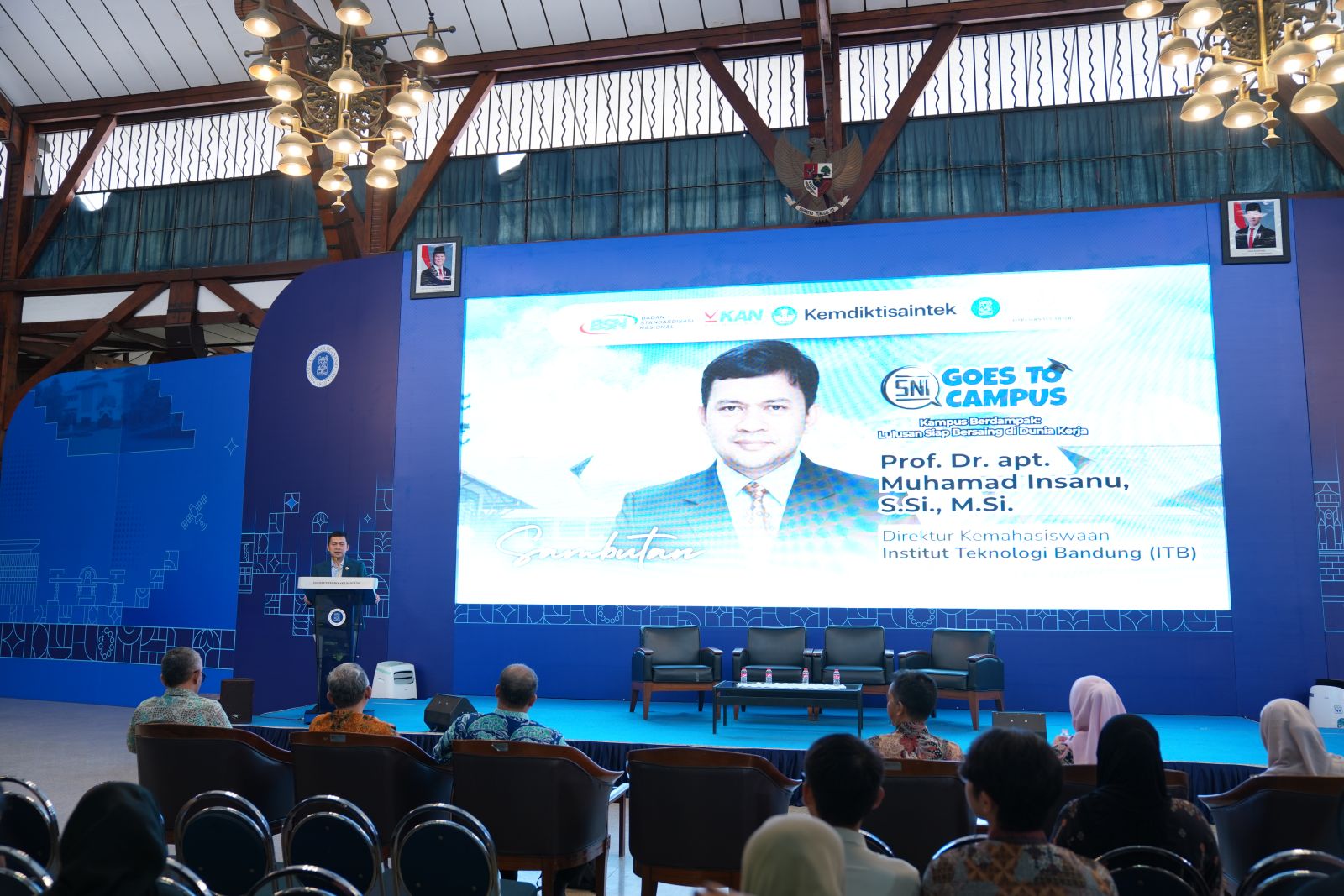
ITB Director of Student Affairs, Prof. Dr. apt. Muhamad Insanu, S.Si., M.Si., delivers remarks at the “SNI Goes to Campus” event held at East Hall, ITB Ganesha Campus, Friday (September 11, 2026).
BANDUNG, itb.ac.id — Institut Teknologi Bandung (ITB) continues to strengthen the role of higher education institutions in fostering a culture of quality and enhancing students’ readiness to enter the industrial world through an understanding of standardization. This commitment was demonstrated through its collaboration in the SNI Goes to Campus program, held at East Hall, ITB Ganesha Campus, on Friday, September 11, 2026.
The event provided a learning platform for students to understand the role of the Indonesian National Standard (SNI) and international standards, their implementation in industry, and the role of the younger generation as informed and responsible consumers. The program also encouraged students to view standardization as an integral part of the ecosystem of innovation, industrial development, and Indonesia’s competitiveness.
ITB Director of Student Affairs, Prof. Dr. apt. Muhamad Insanu, S.Si., M.Si., stated that the participation of higher education institutions in the event highlights the importance of integrating knowledge of standards into the academic environment as essential preparation for students before entering the professional world. Universities hold a strategic position within the standardization ecosystem through knowledge development, the provision of expertise, and the involvement of academics in the development of standards.
The event continued with a keynote speech delivered by Dr. Heru Susanto, S.Pi., M.T., Director of Standards Development for Agro, Chemical, Health, and Conformity Assessment. In his presentation, standardization was highlighted as an important instrument for building a culture of quality while strengthening connections among higher education institutions, industry, government, and society.
During a presentation on Standardization and Conformity Assessment, Hardiles, S.T., M.T., Head of the BSN Technical Service Office, explained that standardization encompasses various aspects, including systems, services, processes, and products. Standards are developed through technical committees involving various stakeholders, including experts, government representatives, business practitioners, and consumers. This mechanism places consensus at the core of producing standards that are relevant and applicable.
“Higher education institutions play an important role in this process. Their contributions can include proposing the development of SNI standards, providing input during standards reviews, and involving academics as experts in the development of standards at the international level,” he said.
Strengthening standardization education has also begun to take place at several higher education institutions through relevant learning programs and courses. In this context, ITB is encouraged to continue serving as one of the role models for higher education institutions in developing standardization competencies.
The relationship between standardization and the professional world was a key topic in the session “Standards-Based Industry,” presented by Raida Shafa Kamilah, S.Stat., M.Ak., Head of the Integrated Management System Division at PT Hartadinata Abadi Tbk. According to Raida, standards play an important role in ensuring product conformity while helping industries meet the demands of global markets. The implementation of standards takes place throughout the entire business process, from raw material selection and production processes to quality control and the delivery of finished products to consumers. This understanding is particularly relevant for ITB students who will enter various industrial sectors.
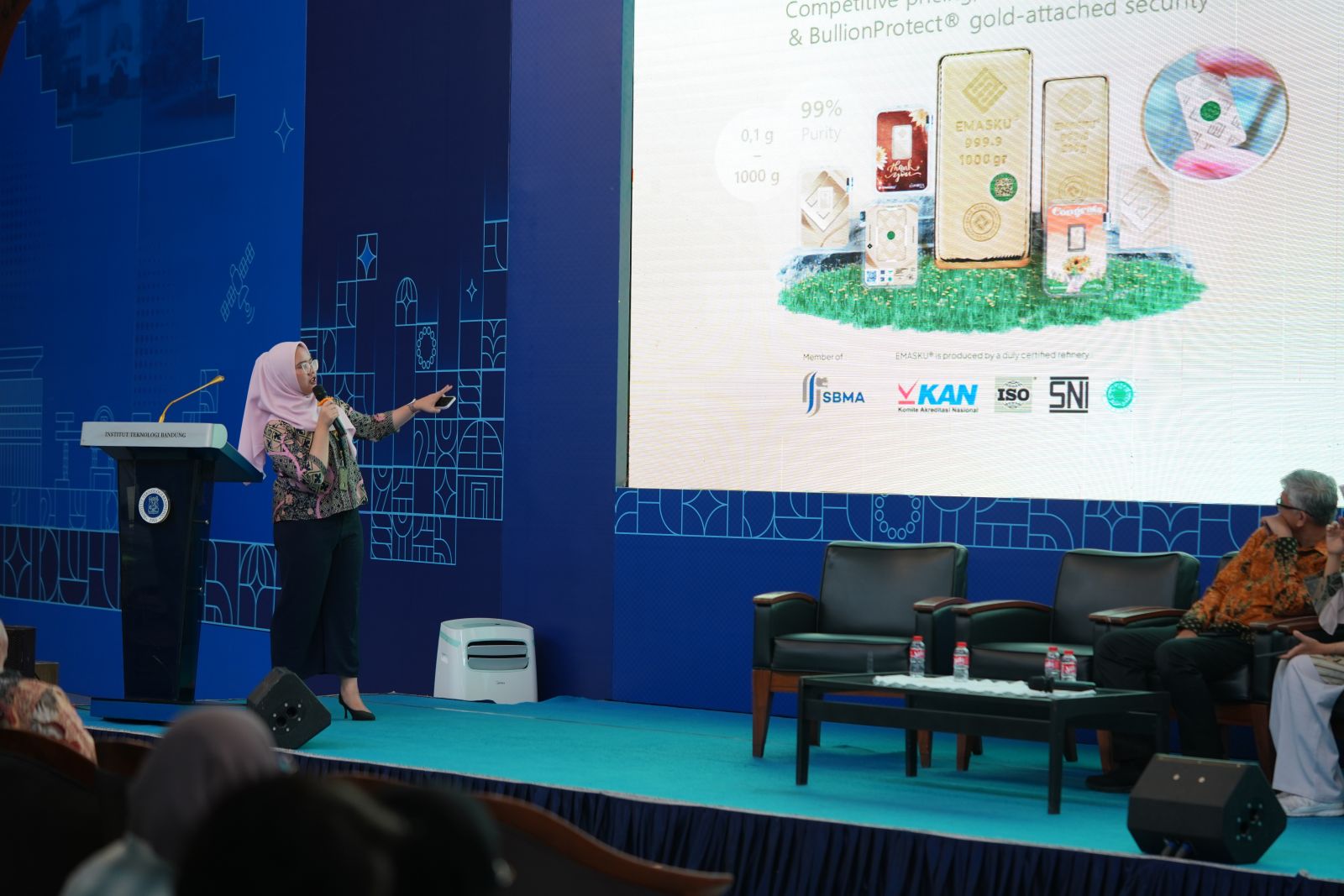
The “Standards-Based Industry” session led by Raida Shafa Kamilah, S.Stat., M.Ak., Head of the Integrated Management System Division at PT Hartadinata Abadi Tbk.
“In addition to academic competencies, students need to possess hard skills, including a basic understanding of regulations and standards, risk-based thinking, and data analysis skills. Meanwhile, soft skills such as attention to detail, documentation, cross-disciplinary communication, and problem-solving are also essential components of implementing standards in a professional environment,” she said.
Another perspective on standardization was presented by Erik Wahyu P., S.P., M.M., Head of the Consumer Protection and Trade Order Division of the West Java Provincial Department of Trade and Industry, through a session entitled “The Younger Generation as Smart Consumer Agents.” He highlighted how SNI is present in various aspects of students’ daily lives.
“From the journey to campus, the use of helmets that meet safety standards is already part of ensuring safety. On campus, various laboratory equipment, electronic devices, and safety equipment are also associated with the implementation of standards,” he said.
Students were encouraged to become critical consumers by understanding the conformity of the products they use and recognizing their rights to report products that do not comply with applicable regulations. This perspective broadens the understanding of standardization within the higher education environment. Students are positioned not only as prospective professionals but also as agents of change who can raise public awareness of product quality, safety, and conformity.
The event also demonstrated ITB’s role as an academic environment that encourages students to develop competencies relevant to global challenges. An understanding of standardization serves as an important foundation for developing graduates who can contribute to improving the quality, competitiveness, and sustainability of Indonesian industries.
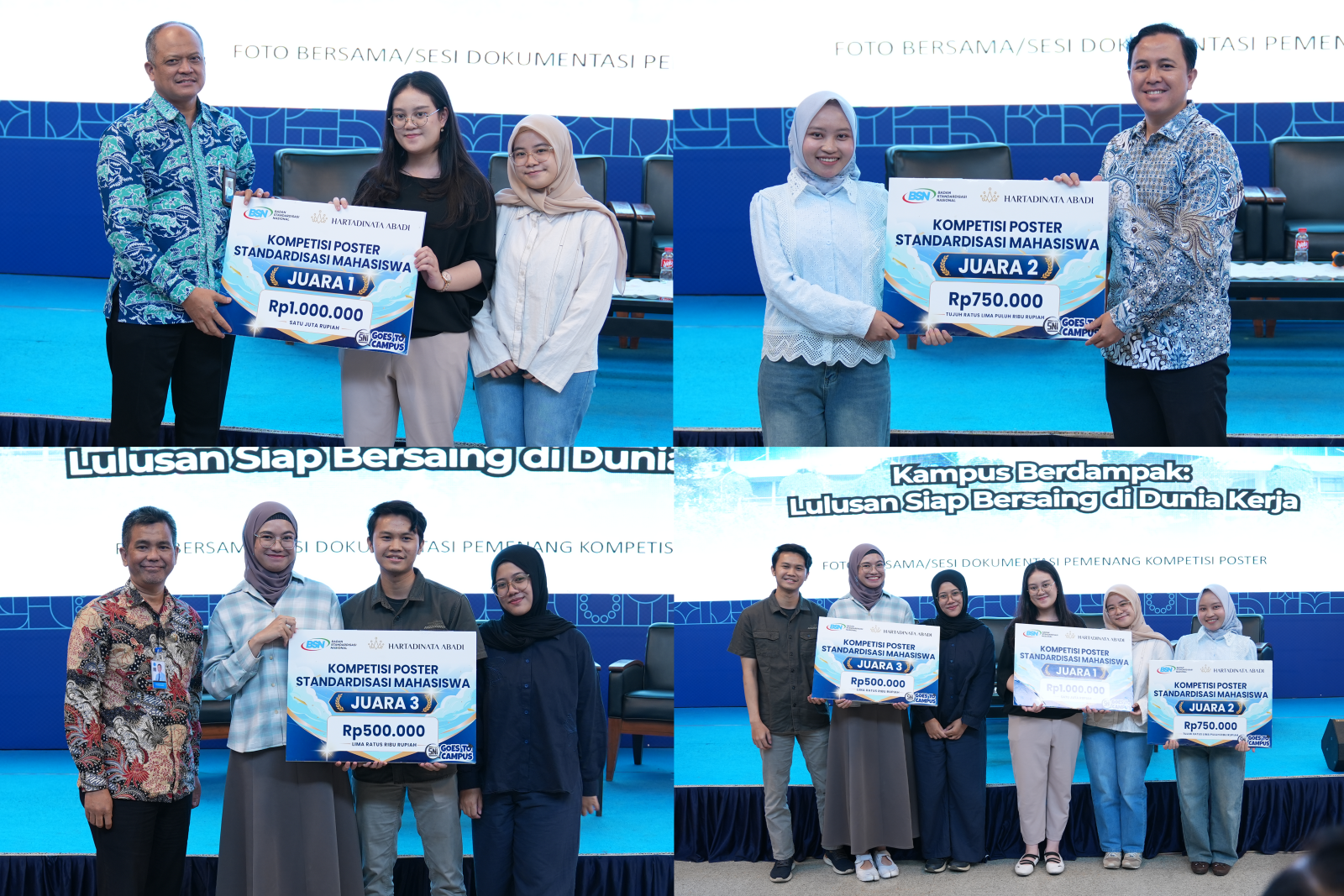
Awarding Ceremony
As the event concluded, the winners of the Student Standardization Poster Competition were announced. The competition provided students with a platform to communicate the importance of standardization through creative approaches while increasing awareness of SNI among the student community. A declaration was also read as a commitment to implementing standardization across various aspects in the future.
“This competition made us more aware of the various applicable regulations, particularly those related to the production of soy sauce, which we chose as the subject of our competition entry. We hope that the hardware and technoware implemented in industry will continue to improve and be better assured through the implementation of SNI or ISO,” said Nazwa and Meliana, the first-place winners of the poster competition.
Source: ITB Official Website



